

Living in a phage-filled world
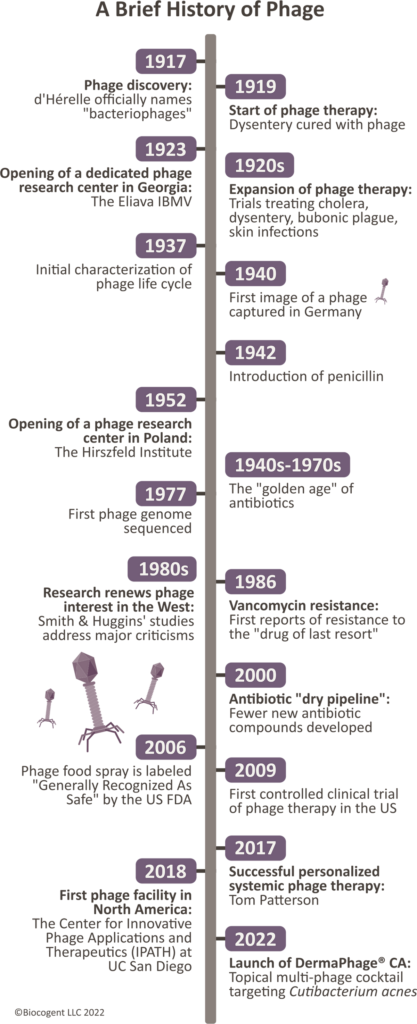
The utility of bacteriophages was almost immediately obvious upon their discovery about a century ago. While working in Paris at the Institut Pasteur, Félix d’Hérelle stumbled upon bacteriophages after noticing that certain microbial filtrates prevented bacterial growth. Referred to simply as phages, these tiny bacteria-killing viruses were first put to work in 1919 when a phage-based treatment was administered to four sick children at l’Hôpital des Enfants-Malades.(1) All of the kids bounced back from bacterial dysentery after receiving what has since been called “phage therapy.”
Over the coming decades, physicians worldwide explored and implemented the clinical use of phages. Phages treated patients with dysentery, cholera, and other bacterial ailments, and phage preparations became commercially available in France and the US. But as the Second World War ended and antibiotics became readily available, phages were forgotten by most. Today, as antibiotics fail against resistant bacteria, science has pivoted the spotlight back to phages to curb unwanted and often harmful bacterial growth.
Early enthusiasm for phage therapy
In the years following their discovery, applications of phage quickly moved from treating chickens with Salmonella gallinarum to healing children infected with Shigella dysentriae. Multiple phage-focused foundations were formed to research and develop phage therapies, including the George Eliava Institute of Bacteriophage, Microbiology, and Virology (IBMV) in Tbilisi, Georgia.
Across the globe, the successful use of phages to treat and prevent human diseases was widespread. Beginning in the mid-1920s, phage against Shigella dysentriae was produced in Brazil and distributed across Latin America to prevent and treat cases of dysentery.(2) In India, clinical trials implementing Vibrio cholerae-targeting phage therapy reduced cholera mortality from 62% to less than 10%.(3) With this success, anticholera phage was also introduced to Indian drinking wells to reduce infection rates during outbreaks.
Phages fall out of favor
Along with the early enthusiasm for phage came some criticism. Some concerns stemmed from the reported variability of efficacy. For example, a phage preparation successfully reduced the bacterial levels of typhoid patients in 1923. However, reports one year later found that the same phage was ineffective in another population of patients.(4) Phage enthusiasts, including d’Hérelle, acknowledged these inconsistencies. They offered possible explanations, including phage specificity obstacles, where the correct phages were not identified and applied. Early practices also saw issues with unreliable manufacturing processes and mishandling phage preparations that rendered phage inactive.
Today, studies are better designed to consider both efficacy and safety for practical use. More recent research has supported remarkable advancements in the commercial manufacturing and distribution of phages. At the same time, increased screening abilities now allow more rapid identification of the problematic bacteria and the desired phages for each specific application.
Despite our current clarity on these issues, phages’ perceived shortcomings at the time discouraged Western physicians from using phage therapy. Easier to produce and deliver, antibiotic compounds became the preferred intervention to clear bacterial infections. The introduction of penicillin in 1942 began the “golden age” of antibiotics, with over 40 antibacterial compounds discovered and implemented over the next 30 years.
Phage wins in Eastern Europe
Despite losing interest in western countries, scientists and physicians in Georgia, Poland, and the former Soviet Union pushed on. The study of phage biology and therapeutics went unabated in Eastern Europe.
Researchers at dedicated phage laboratories, including the Eliava IBMV and the Hirszfeld Institute of Immunology and Experimental Therapy in Wroclaw, Poland, explored phage biology and conducted large-scale clinical trials to further demonstrate the efficacy of phage when properly applied.
For example, throughout the 1960s, over 30,000 children under the age of 7 participated in a trial testing phages’ ability to prevent bacterial dysentery. These prophylactic experiments found that the incidence of dysentery was 3.8 times lower in kids who were getting phage treatment.1 Another large trial saw a 5-fold decrease in typhoid in individuals receiving phage compared to those who were not.(5)
While Eastern European researchers made sizeable advancements in phage research throughout the midcentury, the news was slow to travel. Many phage findings were published in small, non-English journals that were not widely distributed. These barriers, combined with residual political tensions from World War II, significantly dampened interest in phages for antibacterial applications in some regions of the world.(6)
A return to the West
Two researchers, Smith and Huggins, published data throughout the 1980s that addressed common criticisms of bacteriophages. By demonstrating phages’ safety and efficacy, these studies drew attention and began to reignite the potential for phages in Western countries.
These studies addressed concerns about phage stability and delivery. For example, Smith realized that some ingested phages were degraded by the stomach’s acidic conditions and discovered that delivering phages with calcium carbonate helped to preserve phage activity.(7) Further, Smith and Huggins demonstrated that implementing mixtures of multiple different phages, so-called “multi-phage cocktails,” assuaged any worry of phage resistance.(8)
Ultimately, Huggins’ research revealed that the early perceived criticisms of phage therapy were unfounded or less concerning than initially thought, propelling new approaches to phage therapy.
Today’s expanding relevance of phages
Today, it is becoming more widely recognized that phages are remarkable tools for knocking down bacterial growth in a targeted way.
Russia and other eastern European countries continue to use phage cocktails in medicine to treat a wide variety of infections involving respiratory, gastrointestinal, dermatological, and urological diseases and beyond.
The medical use of phage-based medical treatments continues to be developed in the United States. Namely, the Center for Innovative Phage Applications and Therapeutics (IPATH) at the University of California San Diego became North America’s first dedicated phage therapy center. Through institutions like these, phages are used in emergency, life-threatening cases when other interventions prove futile via the Food and Drug Administration’s (FDA) compassionate use program. For instance, the success story of Tom Patterson made headlines in 2017 when his antibiotic-resistant infection cleared after a phage intervention.(9)
Phage therapy is also being further evaluated with numerous clinical trials to demonstrate the efficacy and safety of phages systematically. For example, the first phase I clinical trial in the US tested and confirmed the effectiveness of phage preparations in treating ear infections caused by antibiotic-resistant Pseudomonas aeruginosa.(10) Ongoing clinical trials at Yale University are administering phage nebulizers to cystic fibrosis patients.
The antimicrobial benefits of phages are leveraged in industries beyond the medical field. Microbes are being kept at bay in the food industry by spraying processing equipment, packaging, and the food itself with phage cocktails, with a stamp of approval from the FDA.(11) The bactericidal properties of phages are also put to work in other industries, including skincare, biotechnology, agriculture, veterinary medicine, and environmental protection and remediation.(12)
In 2022, Biocogent LLC announced the launch of DermaPhage® CA, the first natural active skincare ingredient of its kind for blemish-prone skin. DermaPhage CA is a fast-acting bacteriophage cocktail targeting Cutibacterium acnes, a microbial culprit of blemish flare-ups and skin inflammation. The three unique bacteriophages contained in DermaPhage CA demonstrate optimum safety and efficacy for use in facial and body care products, sprayable formulas for linens, or laundry detergents and additives to diminish the growth of C. acnes on the skin.
In fact, Biocogent is launching an entire DermaPhage® category of natural skincare actives. Leveraging established expertise in research and manufacturing, Biocogent will continue to deliver innovative bacteriophage-based products to control problematic bacteria associated with unhealthy skin conditions.
A bright future for phages
With a dynamic past, phages have now become one of the best-studied microbes with an extensive body of scientific literature.(13) Research has built a foundational understanding of phage biology to inform many aspects of applying phage to bacteria-based issues across society.
Ultimately, the time has come for bacteriophages. Once-controlled bacteria are becoming dangerous again as antibiotic resistance is on the rise, and the development of new antibiotic compounds has slowed to a near halt. As robust bacteria-killing viruses, phages are a promising tool to conquer these problematic bacteria.
References and additional readings
- 1 Sulakvelidze, A., Alavidze, Z. & Morris, J. G., Jr. Bacteriophage therapy. Antimicrob Agents Chemother 45, 649-659, doi:10.1128/aac.45.3.649-659.2001 (2001).
- 2 Almeida, G. M. F. & Sundberg, L. R. The forgotten tale of Brazilian phage therapy. Lancet Infect Dis 20, e90-e101, doi:10.1016/s1473-3099(20)30060-8 (2020).
- 3 d’Herelle, F., Lahiri, M. N. & Malone, R. H. Studies on Asiatic Cholera. (Calcutta, 1930).
- 4 Smith, J. The Bacteriophage In The Treatment Of Typhoid Fever. British Medical Journal 2, 47-49, doi:10.1136/bmj.2.3315.47 (1924).
- 5 Lin, D. M., Koskella, B. & Lin, H. C. Phage therapy: An alternative to antibiotics in the age of multi-drug resistance. World J Gastrointest Pharmacol Ther 8, 162-173, doi:10.4292/wjgpt.v8.i3.162 (2017).
- 6 Summers, W. C. The strange history of phage therapy. Bacteriophage 2, 130-133, doi:10.4161/bact.20757 (2012).
- 7 Smith, H. W., Huggins, M. B. & Shaw, K. M. Factors influencing the survival and multiplication of bacteriophages in calves and in their environment. J Gen Microbiol 133, 1127-1135, doi:10.1099/00221287-133-5-1127 (1987).
- 8 Smith, H. W. & Huggins, M. B. Effectiveness of phages in treating experimental Escherichia coli diarrhoea in calves, piglets and lambs. J Gen Microbiol 129, 2659-2675, doi:10.1099/00221287-129-8-2659 (1983).
- 9 Schooley, R. T. et al. Development and Use of Personalized Bacteriophage-Based Therapeutic Cocktails To Treat a Patient with a Disseminated Resistant Acinetobacter baumannii Infection. Antimicrob Agents Chemother 61, doi:10.1128/aac.00954-17 (2017).
- 10 Wright, A., Hawkins, C. H., Anggård, E. E. & Harper, D. R. A controlled clinical trial of a therapeutic bacteriophage preparation in chronic otitis due to antibiotic-resistant Pseudomonas aeruginosa; a preliminary report of efficacy. Clin Otolaryngol 34, 349-357, doi:10.1111/j.1749-4486.2009.01973.x (2009).
- 11 Moye, Z. D., Woolston, J. & Sulakvelidze, A. Bacteriophage Applications for Food Production and Processing. Viruses 10, doi:10.3390/v10040205 (2018).
- 12 Sohail, H. A. et al. Bacteriophages: Emerging Applications in Medicine, Food, and Biotechnology. PHAGE 1, 75-82, doi:10.1089/phage.2020.29004.has (2020).
- 13 Wittebole, X., De Roock, S. & Opal, S. M. A historical overview of bacteriophage therapy as an alternative to antibiotics for the treatment of bacterial pathogens. Virulence 5, 226-235, doi:10.4161/viru.25991 (2014).