
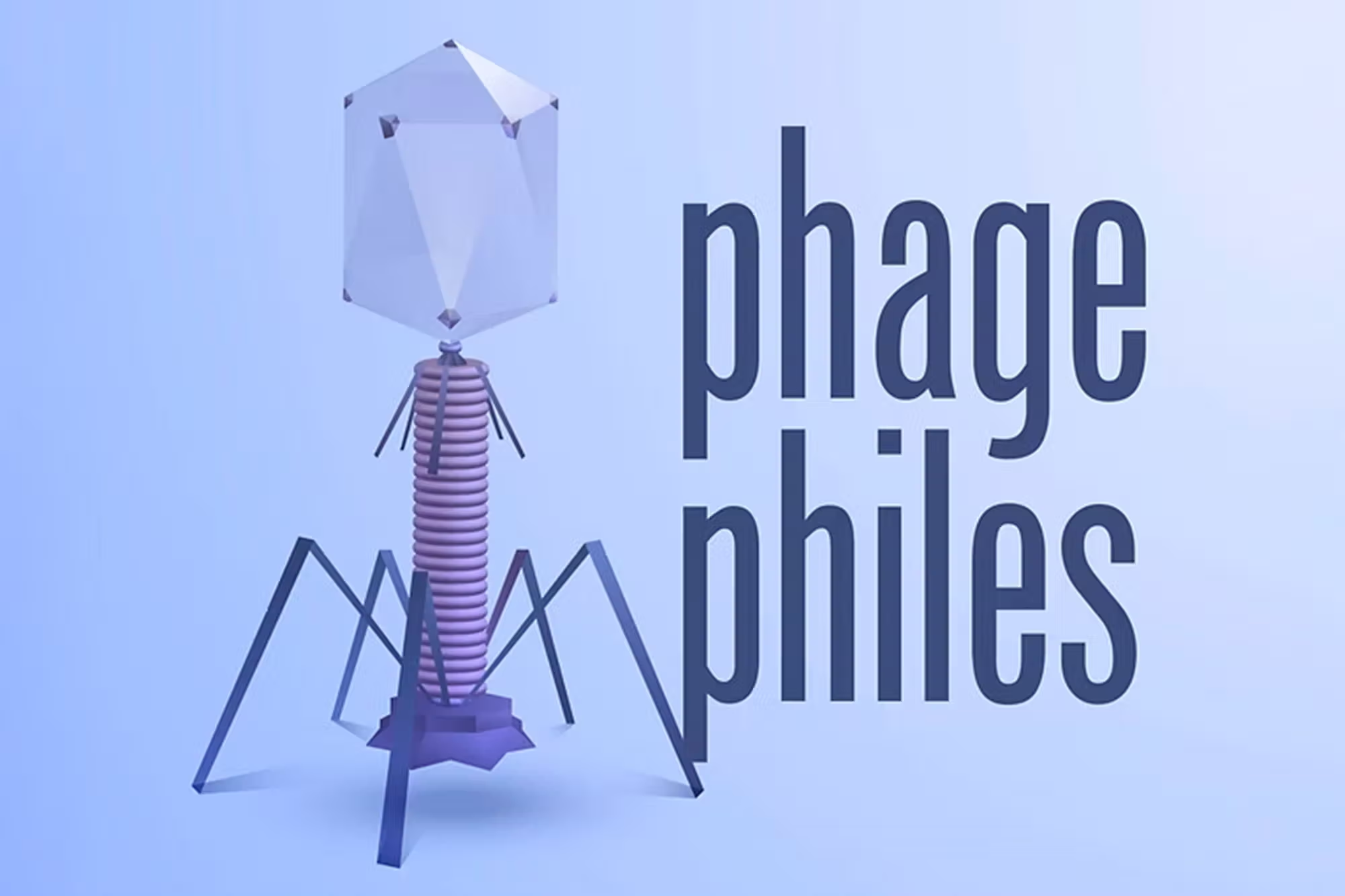
Bacteriophages: What are they?
Bacteriophage means “bacteria eater.” Referred to simply as phages, these microbes are viruses that infect and kill bacteria. As the most common biological entity in nature, phages have been responsible for constraining bacterial growth since microbial life emerged some 3.5 billion years ago. Remarkably, phages kill up to 40% of all marine bacteria every 24 hours.(1)
Bacteriophages may be the most abundant thing you have never heard of. Estimates suggest something like 4.8 x 10(31) phages sprinkled across the world.(1) That is 4.8 nonillion or 48,000,000,000,000,000,000,000,000,000,000 bacteria-killing machines. This inconceivably large number is the equivalent of about one trillion phages for every grain of sand on Earth.
Several thousands of phage varieties exist, each specialized to infect only one or a few types of bacteria. Like other viruses, phages cannot replicate independently and must hijack bacteria’s cellular machinery. To do this, they attach to the outside of a bacterium and inject genetic material inside with directions to assemble new viral particles, which are all released when the bacterial cell lyses, or bursts open.
Where are all of these bacteria-busting viruses hiding? Phages are found wherever bacteria are present. From the bottom of the ocean to lakes and streams, deep in the soil, and even water treatment plants, phages are just about everywhere. Unpolluted freshwater has about 10 million phages in just one drop.(2) Phages will also hitch a ride on plants and animals, and that’s right, humans, too. But don’t worry, phages are harmless to humans. They are only interested in snacking on bacteria.
Over the past decade, the human microbiome (all the bacteria, viruses, fungi, and archaea in and on the body) has been a growing field of research. And along the way, we have learned about the human “phageome,” the collection of phages that regularly reside on people. Researchers have detected phages in healthy individuals’ gut, mouth, lungs, urinary tract, and skin. In fact, one key to good health may be a healthy phageome.(3) Disruptions of this set of common phages shared by healthy individuals are associated with obesity, bowel disorders, acne, and other diseases.
Phage discovery: A brief history
Félix d’Hérelle, a French-Canadian microbiologist, first published reports about the bacteria-killing viruses for which he coined the term ‘bacteriophage’ in 1917. He quickly recognized that phages might be clinically valuable to control bacterial growth and prevent deadly infections. In the first documented use of phage therapeutically, d’Hérelle administered a phage concoction to four sick children at a hospital in Paris, successfully treating them for dysentery in 1919. Throughout the early 20th century, phage therapy centers and commercial phage production plants opened across Europe and India, treating people for dysentery, cholera, bubonic plague, and other bacterial illnesses. Despite early successes, phage therapy fell out of popularity in Western medicine as antibiotics became more readily available. Notably, phage-based research and treatments continued unabated in some regions, including the former Soviet Union and Poland.(4)
Rediscovering the power of phage
Today, the popularity of phages is rising once again in Western medicine. With antibiotic-resistant bacteria becoming a global health crisis, doctors are again turning to bacteriophages to handle deadly bacteria that don’t respond to other measures.(5)
Phages became classified as Generally Recognized as Safe (GRAS) by the US Food and Drug Administration (FDA) for food safety in the early 2000s. The food industry now commonly uses phage sprays to prevent bacterial contamination. Phage formulations applied to food packaging and the food itself (including meat, dairy, fruits, and vegetables) control the growth of foodborne pathogens, including Salmonella spp., Listeria monocytogenes, and Escherichia coli, to name a few. The use of these commercial phage preparations keeps food fresh from farm to fork and curbs the occurrence of foodborne illnesses.
Clinically, phages have proven to be life-saving when antibiotics fall short. In 2016, with emergency use authorization from the FDA, Tom Patterson became one of the first patients in the US to receive phage therapy after his deadly infection proved resistant to all known antibiotics. He quickly bounced back from his illness after receiving a series of custom phage cocktails intravenously. While systemic use of phages is still only done on a case-by-case basis in the US, physicians in Russia, Georgia, and Poland regularly administer phages to manage uncontrollable superbugs found in infections. These successes over the past century support bacteriophages as an essential therapeutic agent for controlling bacterial growth moving forward.
Throughout the Phage Philes, we will investigate many topics related to bacteriophages.
- Examine the details of phage biology: What are phages? How do they infect bacteria? How can we be sure they don’t infect humans?
- Explore applications for phages: How have phages been used therapeutically in humans? What else can they help us with?
- Compare phages with other antibacterial measures: What are the benefits of phages? Could they really replace antibiotics?
- Take a deep dive into the human phageome: Where do people encounter phage? How do phages interact with humans and their microbiome?
Want to learn more about bacteriophages? Check out these sources:
- Wittebole, X., De Roock, S. & Opal, S. M. A historical overview of bacteriophage therapy as an alternative to antibiotics for the treatment of bacterial pathogens. Virulence 5, 226-235, doi:10.4161/viru.25991 (2014).
- Bergh, O., Børsheim, K. Y., Bratbak, G. & Heldal, M. High abundance of viruses found in aquatic environments. Nature 340, 467-468, doi:10.1038/340467a0 (1989).
- Zárate, S., Taboada, B., Yocupicio-Monroy, M. & Arias, C. F. Human Virome. Archives of Medical Research 48, 701-716, doi:https://doi.org/10.1016/j.arcmed.2018.01.005 (2017).
- Sulakvelidze, A., Alavidze, Z. & Morris, J. G., Jr. Bacteriophage therapy. Antimicrob Agents Chemother 45, 649-659, doi:10.1128/aac.45.3.649-659.2001 (2001).
- Kortright, K. E., Chan, B. K., Koff, J. L. & Turner, P. E. Phage Therapy: A Renewed Approach to Combat Antibiotic-Resistant Bacteria. Cell Host & Microbe 25, 219-232, doi:10.1016/j.chom.2019.01.014 (2019).